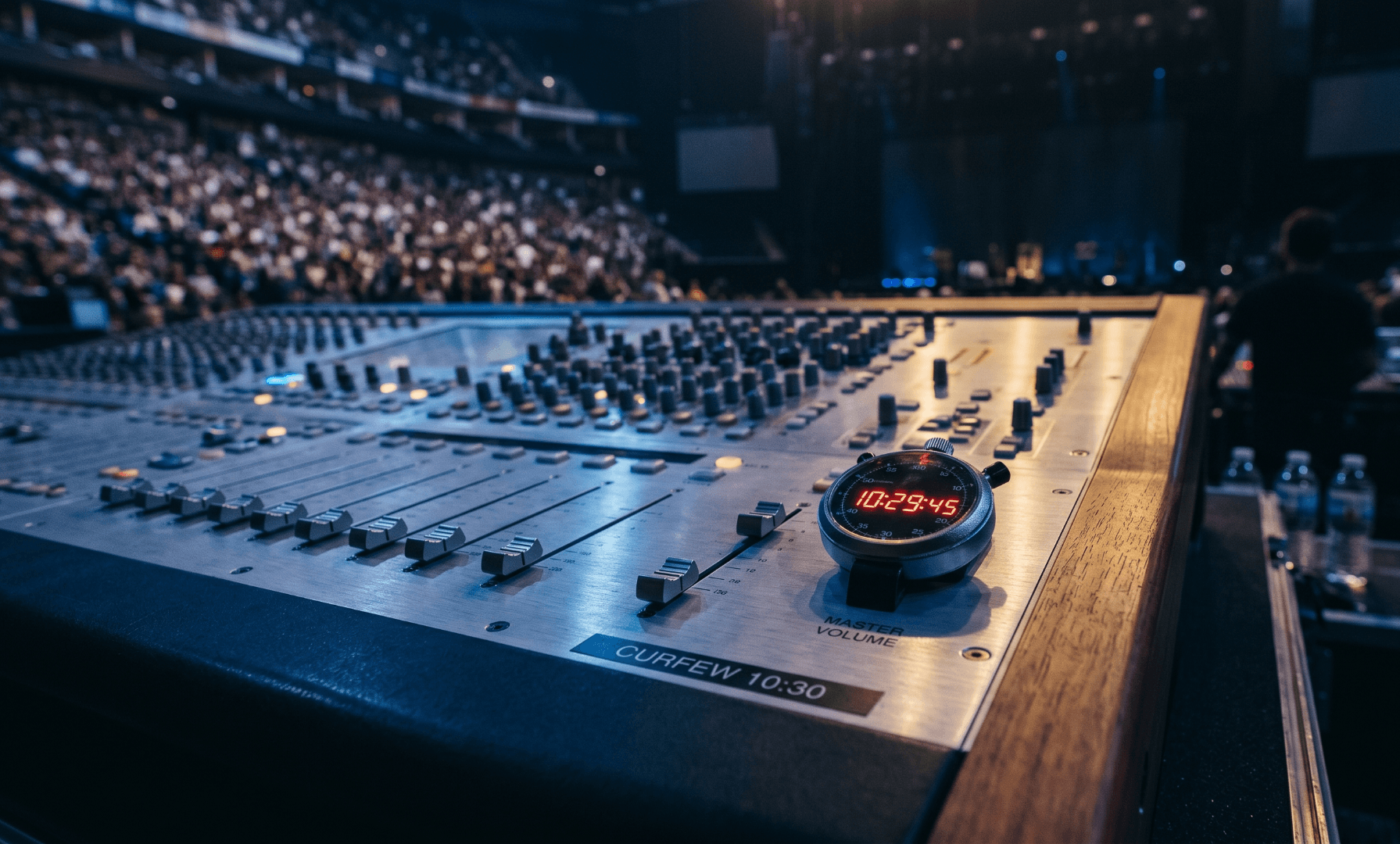
The printed start time on your ticket is a polite fiction. A team of lawyers defending Madonna in federal court successfully argued that "no reasonable concertgoer" expects a headliner to appear at the printed time. That case was dismissed. The precedent stands.
Concerts run late for a long list of reasons, and almost none of them are accidental. Behind the gap between "doors open 7:00 p.m." and the moment the lights go down, there is a full industrial logic operating at every level of the night.
A typical arena show involves roughly 16 to 20 hours of work for a two-hour performance. Trucks arrive at 6 or 8 in the morning. Rigging goes in through the late morning. Audio, lighting and LED walls are deployed through the afternoon. By evening, there is a 60 to 90-minute soundcheck window, and it is the most fragile point in the whole day because it depends on everything that came before it running on schedule.
Support acts typically run 30 to 45 minutes, with 15 to 30-minute changeovers between each act to reset the stage, re-patch the audio, and re-tune the monitors. In arenas, the headliner usually appears 90 to 150 minutes after the advertised show time. At festivals, almost never before 9 or 10 p.m. When a support overruns by ten minutes, the whole evening shifts. On the night Lenny Kravitz ran ten minutes late opening for Guns N' Roses at Gillette Stadium, GN'R had to trim songs from their set to avoid blowing the curfew.
This is the part most people do not realise: in the UK and most of Europe, the end time is non-negotiable. A late start does not mean a late finish. It means a shorter show.
Major London outdoor sites including Hyde Park and Wembley operate under a 10:30 p.m. curfew set by premises licence conditions. In 2012, Bruce Springsteen and Paul McCartney were mid-song when Live Nation cut their microphones at 10:40 p.m. to comply with the Westminster licence. The regulatory response was severe: Hyde Park concerts were cut from 13 to 9 per year and crowd caps reduced from 80,000 to 65,000. As one observer put it at the time, had things been ready for Springsteen to start at 7, he would have made the curfew.
In the UK, overruns get cut off or fined. Madonna was fined £135,000 for a 40-minute Wembley overrun in 2008. Arijit Singh's sound at Tottenham Hotspur Stadium was cut mid-song at exactly 10:30 p.m. in September 2025. The licence is the licence.
In the US it works differently. Instead of a hard cut, venues charge overtime. Madison Square Garden reportedly bills union crew at rates that can reach $10,000 per minute past curfew. Coachella charges $20,000 for the first five minutes over, then $1,000 per additional minute. Paul McCartney paid around $50,000 after running 50 minutes past curfew in 2009. Morgan Wallen paid $15,705 after finishing 14 minutes late at Gillette Stadium in August 2025.
Some delays are structural. Some are one person refusing to walk out.
Axl Rose is the most documented example. His own guitarist Richard Fortus described it on a podcast: "It's two hours after we're supposed to start, three hours, stadiums full of people just booing. And the second he'd walk out on stage, all that energy right into the palm of his hand." His original manager attributed it to stage fright. Axl himself told Rolling Stone: "That hour-and-a-half or two-hour time period that I'm late going onstage is living hell." The costs have been real. In Vancouver in 2002, fans rioted when Rose was still airborne from Los Angeles 90 minutes before curtain.
Lauryn Hill has made lateness a recurring story. At Atlanta's Chastain Park Amphitheater in 2016 she arrived more than two hours late and played 37 minutes before curfew ended the show. Live Nation issued full refunds. Hill's response referenced "aligning energy." At Essence Festival 2025 she performed at 2:30 a.m. to an essentially empty arena.
Madonna's case is now legal doctrine. Four separate lawsuits have been filed over late starts on her tours. Her defence team's successful argument: "No reasonable concertgoer, and certainly no Madonna fan, would expect the headline act at a major arena concert to take the stage at [8:30 p.m.]." She said from the D.C. stage: "I am sorry I am late. No, I am not sorry, it's who I am. I'm always late."
The promoter and venue side of this is rarely discussed openly, but the industry has been unusually honest about it when pressed.
Peter Shapiro, owner of Brooklyn Bowl, told Billboard directly: "Just like when Jamie Lee Curtis' movies play in theaters, they need to sell popcorn. Most of our margin is on drinks." Dayna Frank, head of First Avenue: "Most of the ticket price goes on to the band, so what venues subsist on is beverages." An anonymous tour manager quoted in Billboard put it plainly: "These venues and promoters believe that the longer people stay, the more alcohol they will purchase. Alcohol sales make the live music industry go round."
Bar sales account for 80 to 90% of turnover at independent venues. The standard 60 to 90-minute gap between doors opening and the first act is not neutral time. It is two rounds of drinks, merch browsing, and the lighting and playlist choreography that makes the room feel full before anyone has played a note. Festivals stagger stages for the same reason, partly to keep the audience moving and spending across the site.
Know the rules before you go. In the UK, if a show is running late, the curfew still applies: your headliner may start 40 minutes behind schedule but they will finish on time, which means your set is 40 minutes shorter. Pay attention to the actual advertised show time, not just the doors time, and build in that buffer on the way home.
The honest summary is that concerts start late because almost every incentive in the system pushes them later, and the only countervailing force, the licensing authority, shortens the set rather than advancing the start. That is unlikely to change soon. What you can do is go in with accurate information. Sign up to Pyngo to follow the events you care about and get notified the moment tickets go live, so at least the part before the show goes smoothly.
Get alerts when tickets drop and join genuine conversations that give you the best odds to see the events you love.
Did you enjoy this read?
